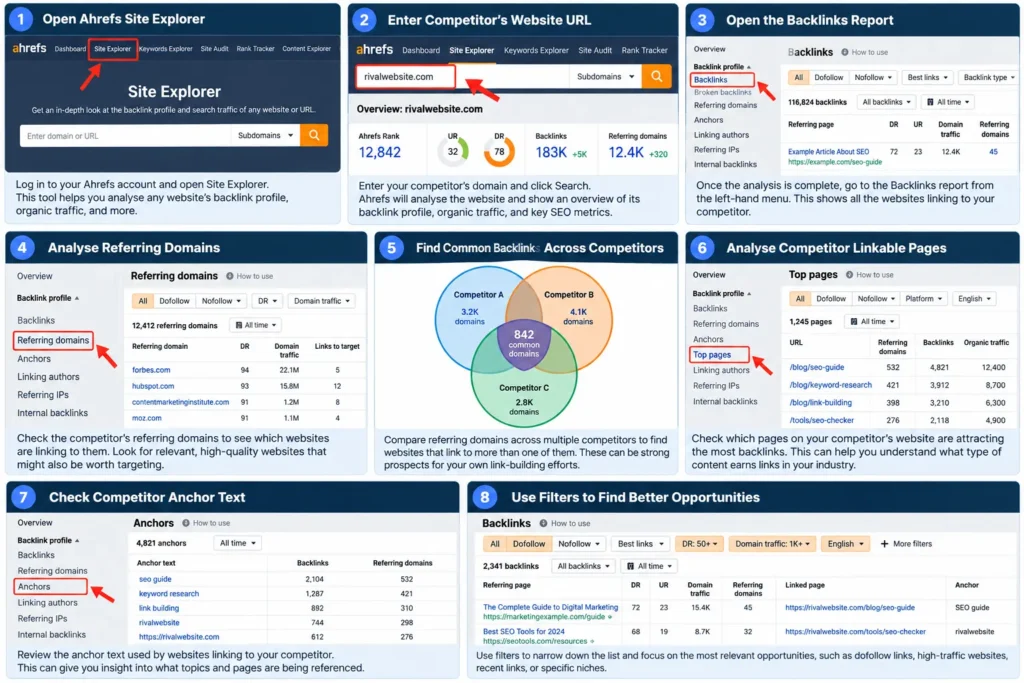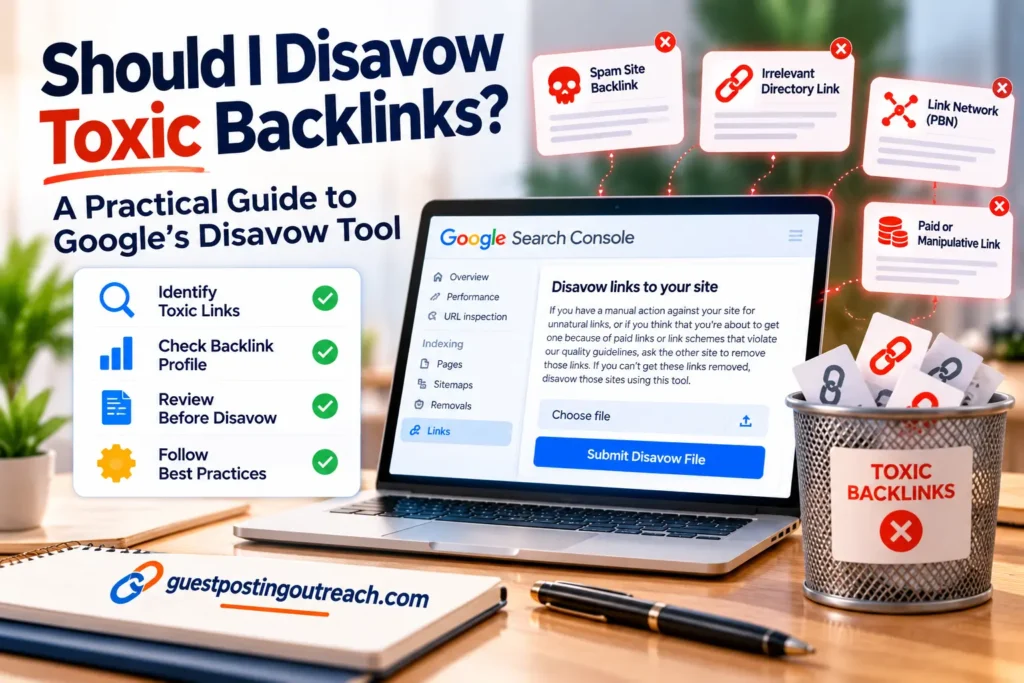
Toxic backlinks can make website owners nervous, especially when an SEO tool reports hundreds or thousands of potentially harmful links pointing to their domain. But seeing a long list of “toxic” or “spammy” backlinks does not automatically mean you should disavow them.
Google has become much better at identifying and ignoring many low-quality or unnatural links. In most situations, website owners do not need to manually remove every suspicious backlink.
However, there are circumstances where reviewing and disavowing backlinks can be appropriate, particularly when a website has a significant number of artificial links or has received a manual action related to unnatural links.
This guide explains what toxic backlinks are, how to identify them, when you should consider using Google’s Disavow Tool, and what to check before submitting a disavow file.
What Are Toxic Backlinks?
Toxic backlinks are links pointing to your website that may be considered low-quality, spammy, irrelevant, or artificially created.
The term “toxic backlink” is commonly used by SEO tools, but it is not a specific Google classification. Tools such as Semrush and other backlink analysis platforms use their own signals to identify links that may deserve further investigation.
A suspicious backlink might come from:
- A website created primarily for SEO manipulation
- A page containing large numbers of unrelated outbound links
- A link network or private blog network
- Automatically generated or scraped content
- An irrelevant website with obvious spam patterns
- Paid or exchanged links intended to manipulate rankings
- Links created through automated link-building software
However, a low-authority or irrelevant backlink is not automatically harmful.
For example, a small website linking to your article because the author genuinely found it useful may be perfectly natural, even if the website has little domain authority.
The important question is not simply:
“Does this website have a low score?”
Instead, ask:
“Was this link created in a way that violates Google’s spam policies or is there evidence that it is part of an unnatural link scheme?”
How to Identify Potentially Harmful Backlinks
Before considering a disavow file, you need to understand your backlink profile.
A backlink audit can help you identify unusual patterns and determine which links actually require attention.
Look for unnatural link patterns
Some common warning signs include:
Links from obvious spam websites:
Domains containing automatically generated pages, irrelevant keywords, scraped content, or excessive advertising may deserve closer inspection.
Irrelevant sitewide links:
A large number of links from unrelated websites, particularly when they appear in footers, sidebars, or widgets, can be a warning sign.
Paid links designed to manipulate rankings:
Buying links specifically to pass ranking credit can violate Google’s spam policies.
Links from private blog networks:
A network of websites created primarily to manipulate search rankings can create an unnatural backlink pattern.
Automated link building:
Large numbers of links generated using automated software can indicate manipulative activity.
Over-optimized anchor text:
A backlink profile dominated by exact-match commercial keywords can sometimes indicate deliberate link manipulation.
None of these signals should be considered in isolation. Context matters.
Are All Low-Quality Backlinks Toxic?
No.
This is one of the most important things to understand before using Google’s Disavow Tool.
Your website may naturally collect backlinks from:
- New websites
- Small blogs
- Forums
- Directories
- Irrelevant pages
- Websites with low domain authority
- User-generated content
- Scraped pages
That does not necessarily mean those links are damaging your rankings.
Google’s systems are designed to assess and ignore many types of spammy or manipulative links. Therefore, seeing hundreds of questionable backlinks in Ahrefs, Semrush, or another SEO tool does not automatically mean you need to disavow them.
Why SEO tool toxicity scores should not be treated as Google penalties
Third-party tools use their own algorithms and metrics.
A backlink marked as “toxic” by an SEO platform is essentially a signal for investigation, not a confirmation that Google considers the link harmful.
For this reason, don’t create a disavow file simply because a tool reports a high toxicity score.
Review the actual backlinks and the circumstances in which they were created first.
Tools for Checking Your Backlink Profile
Several tools can help you investigate backlinks and identify unusual patterns.
Google Search Console
Google Search Console provides Google’s own Links report, which can help you understand the websites and pages linking to your domain.
It is also important for checking whether Google has issued a manual action against your website.
Ahrefs
Ahrefs can be useful for analyzing:
- Referring domains
- Backlink growth
- Anchor text
- Lost and new backlinks
- Link attributes
- Referring pages
Its data can help you investigate suspicious patterns, but its link-quality metrics should not be treated as Google’s official judgment.
Semrush
Semrush’s Backlink Audit tool can identify potentially suspicious links and organize them for further review.
Again, use the results as a starting point for investigation rather than automatically disavowing everything the tool flags.
Can Toxic Backlinks Hurt SEO?
Potentially, but the situation is more nuanced than simply having a few bad links.
Google’s systems can generally ignore many unnatural or low-quality links. The bigger concern is when a backlink profile contains evidence of deliberate manipulation, particularly when links were created to influence Google’s rankings.
Manual actions
A manual action is different from an algorithmic ranking change.
If Google’s spam team determines that a website violates Google’s spam policies, the site may receive a manual action.
Google Search Console will provide information about manual actions affecting the site.
If the manual action involves unnatural links, you may need to identify and address the problematic links before submitting a reconsideration request.
Algorithmic changes
A ranking decline does not automatically mean that toxic backlinks caused the problem.
Traffic and rankings can change for many reasons, including:
- Algorithm updates
- Competitor improvements
- Search intent changes
- Technical SEO problems
- Content quality issues
- Indexing problems
- Changes in search demand
Therefore, don’t assume that a ranking drop after discovering suspicious backlinks means you need to disavow them.
Negative SEO concerns
Website owners sometimes worry that competitors can destroy their rankings simply by pointing thousands of spam links at their website.
Google has systems designed to prevent many such attacks from causing ranking problems.
If you notice a sudden increase in spam backlinks, don’t immediately panic or upload a disavow file.
First determine whether there is actually evidence of an unnatural link problem affecting your website.
Should You Disavow Toxic Backlinks?
Usually, no.
You generally should not disavow backlinks simply because they have low authority, look unusual, or are classified as “toxic” by an SEO tool.
Google’s guidance indicates that most websites do not need to use the Disavow Tool.
Disavow can become relevant when you have a considerable number of spammy, artificial, or low-quality links and those links have caused, or are likely to cause, a manual action.
The decision should therefore be based on the overall backlink situation rather than the number shown in an SEO tool.
When Should You Consider Using the Disavow Tool?
There are several situations where a disavow may be worth considering.
1. You Have a Manual Action for Unnatural Links
This is one of the clearest situations where investigating and addressing backlinks becomes important.
If Google Search Console reports a manual action related to unnatural links, review the links responsible and attempt to remove them where possible.
If you cannot get the problematic links removed, a disavow file may be part of the recovery process.
2. You Have a Large Number of Artificial Links
If your website previously used aggressive link-building tactics such as:
- Paid links
- Link networks
- Automated backlink software
- Large-scale link exchanges
- Keyword-rich anchor text campaigns
you may have a stronger reason to conduct a detailed backlink review.
The focus should be on identifying links created through manipulative practices rather than simply targeting every low-quality domain.
3. You Know That Past SEO Work Created Manipulative Links
Sometimes the history of a website provides important context.
For example, a previous SEO provider may have built thousands of links through directories, private networks, automated systems, or other manipulative methods.
If you know those links were deliberately created to manipulate rankings, they deserve closer investigation.
When Should You NOT Disavow a Backlink?
There are also many situations where disavowing links is unnecessary.
A backlink has low domain authority
Low authority does not automatically mean a link is harmful.
A website is unrelated to your industry
An irrelevant link may be meaningless from an SEO perspective, but that does not automatically make it dangerous.
An SEO tool gives the link a toxic score
Third-party toxicity scores are useful for prioritizing investigation, not for making automatic disavow decisions.
You have received spam links naturally
Websites often accumulate unwanted links without actively building them. You generally don’t need to disavow every automatically generated or suspicious link you discover.
Your rankings suddenly dropped
A ranking decline alone isn’t proof that backlinks caused the problem.
Investigate technical SEO, content, competitors, search intent, indexing, and recent Google updates before blaming your backlink profile.
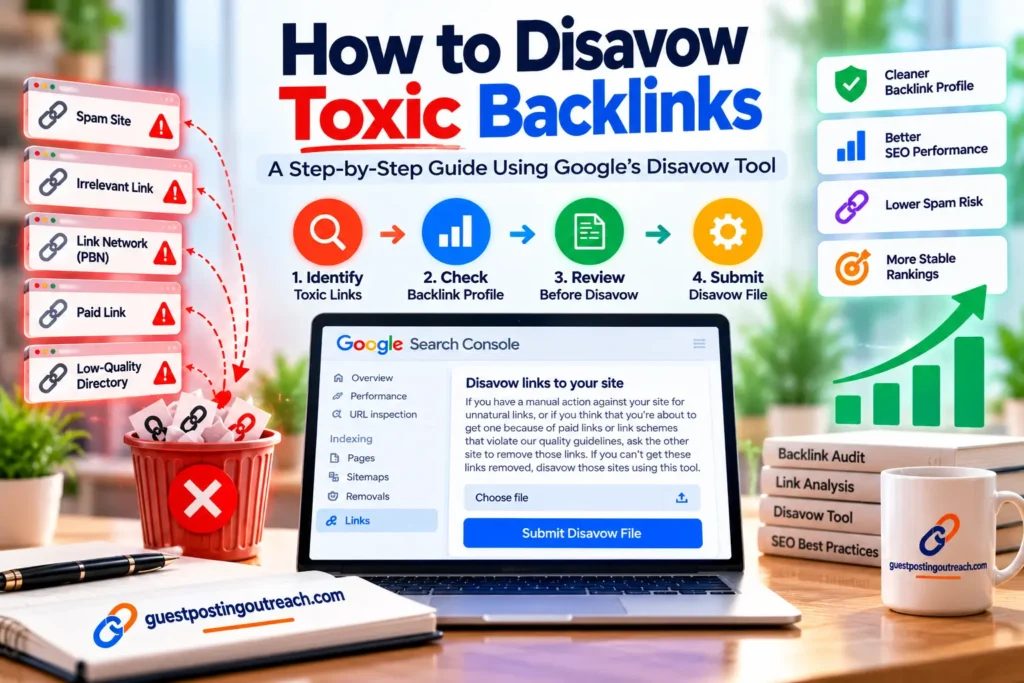
How to Disavow Toxic Backlinks
If you have determined that a disavow is appropriate, the process requires care.
Step 1: Perform a backlink audit
Collect backlink data from reliable sources and review:
- Linking domains
- Target pages
- Anchor text
- Link context
- Link placement
- Follow/nofollow attributes
- Acquisition history
- Signs of manipulation
Don’t rely on a single third-party metric.
Step 2: Identify genuinely problematic links
Separate suspicious links from links that are simply low quality.
Ask:
Was the link created naturally?
Was it created by me, an agency, or a previous SEO provider?
Was it intended to manipulate rankings?
Is there a pattern across many domains?
Is there evidence of a link scheme?
This contextual review is much more useful than blindly disavowing every suspicious backlink.
Step 3: Try to remove links when appropriate
If you control the website where the links were created, remove them.
If an SEO agency created the links, contact them and ask whether they can help identify or remove the problematic placements.
However, you don’t need to spend excessive time trying to remove every random spam link that happens to point at your website.
Step 4: Prepare the disavow file carefully
Google’s Disavow Tool accepts a properly formatted text file containing URLs or domains you want Google to ignore when evaluating your site’s links.
For example:
# Disavow specific domain
domain:example-spam-site.com

# Disavow another domain
domain:another-spam-site.com
Only include domains or URLs that you have a strong reason to disavow.
Step 5: Submit the file through Google
Google provides the Disavow Links Tool through Search Console for eligible websites.
Because disavowing links can have unintended consequences if used incorrectly, review the file carefully before submitting it.
Building a healthy backlink profile is not only about removing suspicious links. It is equally important to focus on earning relevant, high-quality backlinks through legitimate methods. Guest posting outreach agency can help businesses connect with relevant websites and publishers to secure contextual links through useful, original content. When outreach focuses on genuine relevance and editorial value rather than bulk link placement, it can support a more natural and sustainable link-building strategy.
Should You Disavow an Entire Domain?
Sometimes a domain-level disavow can make sense when you are confident that the domain contains a pattern of artificial links pointing to your site.
For example, if a large number of clearly manipulative links originate from the same domain, you may decide to disavow the entire domain rather than listing individual URLs.
However, don’t use:
domain:example.comsimply because the domain has a low authority score.
The decision should be based on the nature of the links and the reason they were created.
What Happens After You Disavow Backlinks?
Disavowing links does not guarantee an immediate ranking improvement.
It is essentially a way of telling Google that you do not want certain links to be considered when evaluating your site’s backlink signals.
If your website was not being negatively affected by the links in the first place, you may see little or no change.
If you are dealing with a manual action, disavowal may be one part of a broader cleanup process, but you still need to follow Google’s instructions and address the underlying issue.
How Often Should You Perform a Backlink Audit?
There is no universal schedule that every website needs to follow.
However, regular backlink monitoring can be useful for websites that:
- Actively build links
- Have a large backlink profile
- Have used multiple SEO agencies
- Have experienced suspicious link-building activity
- Have previously received a manual action
- Operate in highly competitive search results
For many businesses, reviewing backlink growth and unusual referring domains periodically is more useful than constantly trying to remove individual low-quality links.
Common Mistakes When Disavowing Backlinks
Disavow decisions can go wrong when website owners act too aggressively.
Disavowing everything marked “toxic”
This is perhaps the most common mistake.
A third-party tool’s toxicity label does not mean Google has classified the backlink as harmful.
Removing legitimate backlinks
An unnecessarily aggressive disavow can cause you to discount links that may actually contribute positively to your site’s authority and visibility.
Assuming every ranking drop is backlink-related
SEO performance depends on many factors. A backlink audit should be part of a broader investigation.
Using the disavow file without understanding the problem
If you’re unsure why certain links are being disavowed, it is better to investigate further before submitting the file.
Once you have reviewed your backlink profile, the next step is to focus on building quality links from relevant websites. Blogger outreach is one approach that involves connecting with bloggers and website owners to earn relevant placements within valuable content. Choosing websites based on niche relevance, content quality, and genuine audience value can help you build a stronger backlink profile without relying on manipulative link-building practices.
Final Thoughts
So, should you disavow toxic backlinks?
In most cases, not simply because an SEO tool has labelled them as toxic.
Google can ignore many low-quality and spammy links automatically. A few irrelevant, low-authority, or suspicious backlinks are not necessarily a reason to use the Disavow Tool.
The situation is different when you have evidence of significant artificial link activity, particularly when your website has received a manual action related to unnatural links or you have a history of manipulative link building.
The safest approach is to audit your backlink profile, investigate suspicious patterns, distinguish genuinely manipulative links from ordinary low-quality links, and only use the disavow process when there is a clear reason to do so.
A careful backlink audit is usually a better first step than immediately uploading a disavow file.
Frequently Asked Questions
What are toxic backlinks?
Toxic backlinks are commonly described as low-quality, spammy, irrelevant, or artificially created links that may present an SEO risk. However, “toxic backlink” is not a specific Google classification, and links flagged by SEO tools should be investigated rather than automatically disavowed.
Should I disavow every toxic backlink?
No. You should not automatically disavow every backlink that an SEO tool labels as toxic. Google can ignore many low-quality links, and unnecessarily disavowing legitimate links may create problems.
Can toxic backlinks cause a Google penalty?
Artificial links created to manipulate Google’s rankings can contribute to a manual action. However, simply having some spammy or low-quality backlinks does not mean your website will automatically receive a penalty.
How do I find toxic backlinks?
You can use Google Search Console, Ahrefs, Semrush, and other backlink analysis tools to identify unusual links and patterns. The important step is manually evaluating the context and origin of suspicious backlinks.
Does Google automatically ignore bad backlinks?
Google has systems that can identify and ignore many spammy or unnatural links. This is one reason why most website owners do not need to use the Disavow Tool simply because they discover low-quality backlinks.
When should I use Google’s Disavow Tool?
The tool is generally intended for situations where there are a considerable number of spammy or artificial links and those links have caused, or are likely to cause, a manual action. It should be used carefully.
Can disavowing backlinks improve rankings?
It can help in situations where problematic artificial links are genuinely affecting a site’s link profile, particularly as part of addressing a manual action. However, disavowing links is not a general-purpose ranking improvement technique.
How often should I check my backlinks?
There is no fixed schedule required for every website. Businesses actively building links or managing large backlink profiles can benefit from periodic backlink reviews, especially when there are unusual changes in referring domains or anchor text patterns.

Narender Malik is an SEO strategist with 8 years of experience building search growth through technical SEO, authority-driven link building, and strategic blogger outreach. He takes a data-led approach to off-page SEO, identifying the right opportunities, publishers, and digital ecosystems to strengthen brand authority and organic performance. His work focuses on building sustainable SEO assets that deliver meaningful visibility, qualified traffic, and long-term growth.