Outreach is an important part of modern SEO, especially when a business wants to earn backlinks, build publisher relationships, promote content, or reach relevant websites. But there is a major difference between manual outreach and automated outreach, and choosing the wrong approach can affect the quality of campaigns, response rates, relationships, and long-term SEO results.
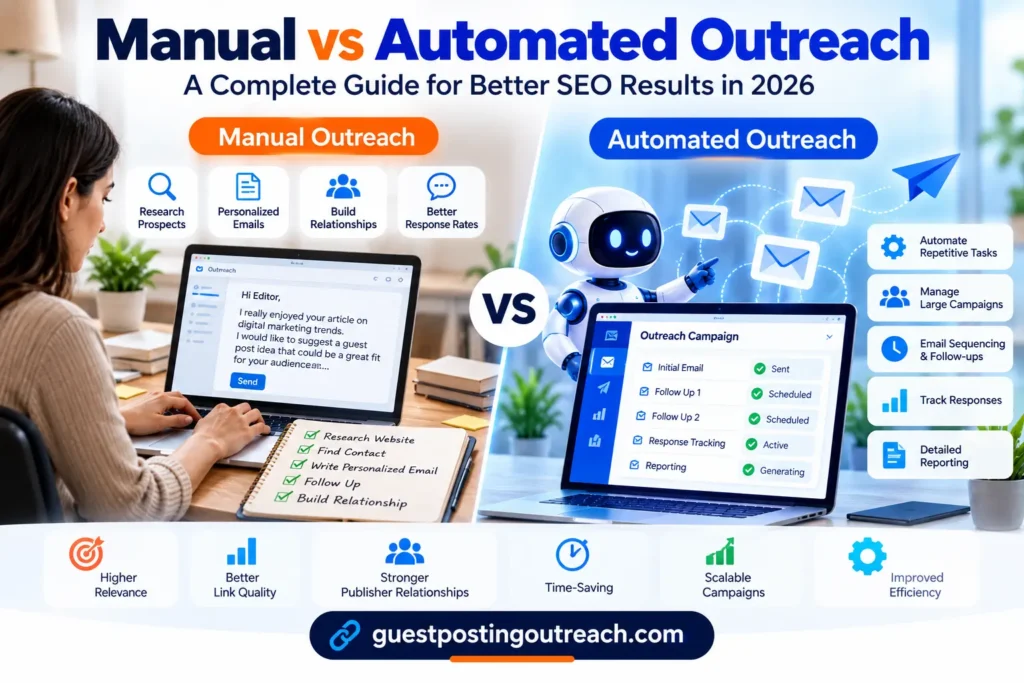
Manual outreach involves researching prospects individually, understanding their websites, finding the right contact, and sending personalized messages. Automated outreach uses software or workflows to handle repetitive tasks such as prospect discovery, email sending, follow-ups, and campaign management.
Neither approach is automatically better in every situation. The right choice depends on campaign size, goals, available resources, personalization requirements, and the quality of prospects being targeted.
This guide explains the difference between manual and automated outreach, how each method works, their advantages and limitations, and when businesses should use one or combine both.
What Is Manual Outreach?
Manual outreach is a process in which an outreach specialist handles most campaign activities individually.
Instead of sending the same message to hundreds or thousands of websites, the marketer researches each prospect and creates a more relevant approach based on the website, audience, content, or business.
A typical manual outreach campaign may involve:
- Finding relevant websites or prospects.
- Checking website quality and relevance.
- Identifying suitable pages or content opportunities.
- Finding an appropriate contact person.
- Reviewing the prospect’s website and previous content.
- Writing a personalized email.
- Sending the outreach message.
- Managing replies individually.
- Negotiating or discussing opportunities.
- Following up when appropriate.
- Tracking placements, responses, and campaign outcomes.
For example, a guest post outreach specialist may review a technology website before contacting its editor. Instead of simply saying, “I want to submit a guest post,” the email can reference the site’s existing content and suggest a topic that fits its audience.
That extra research takes time, but it can make the outreach more relevant.
What Is Automated Outreach?
Automated outreach uses software to perform some or most repetitive campaign tasks.
Depending on the platform, automation may help with:
- Prospect management
- Email sequencing
- Follow-up reminders
- Contact organization
- Campaign tracking
- Personalization fields
- Response monitoring
- Reporting
For example, an outreach tool may send an initial email and automatically send a follow-up several days later if no response is received.
Automation can significantly reduce repetitive work, especially when a campaign contains a large number of prospects.
However, automation does not automatically mean better outreach. Poorly researched prospects combined with generic messaging can result in low-quality campaigns even when the software works perfectly.
Manual vs Automated Outreach: Key Difference
The simplest difference is control versus scalability.
Manual outreach gives the marketer greater control over research, personalization, communication, and decision-making.
Automated outreach makes it easier to manage repetitive tasks across a larger number of prospects.
| Factor | Manual Outreach | Automated Outreach |
|---|---|---|
| Research | Highly personalized | Often partially automated |
| Personalization | Usually high | Depends on setup |
| Scalability | Limited | High |
| Speed | Slower | Faster |
| Prospect qualification | Detailed | Can be rule-based |
| Follow-ups | Manually managed | Automatically scheduled |
| Relationship building | Stronger potential | Can feel impersonal |
| Repetitive tasks | Time-consuming | Efficient |
| Campaign control | Very high | Depends on software |
| Best for | Quality-focused campaigns | Larger campaigns |
The important point is that automation and personalization are not opposites. A well-designed campaign can use automation for repetitive work while keeping important decisions and communication under human control.
Manual vs Automated Outreach for SEO
The difference becomes particularly important when outreach is being used for SEO.
Link building is not simply about obtaining as many backlinks as possible. Relevance, editorial context, website quality, placement, and the overall backlink profile matter.
Manual outreach can help an SEO team evaluate whether a website is actually relevant before contacting it.
For example, suppose a company sells accounting software. A manual outreach process could identify websites covering:
- Accounting
- Small business finance
- Entrepreneurship
- Business technology
- Tax management
- SaaS tools
The marketer can then assess whether each website has useful content, a relevant audience, and a legitimate reason to publish the proposed article.
Automated tools can help organize that prospect list and manage communication, but the quality of the campaign still depends on the underlying research.
Advantages of Manual Outreach
1. Better Personalization
One of the biggest benefits of manual outreach is the ability to personalize communication.
A marketer can reference a specific article, publication style, audience, or content gap instead of relying entirely on generic variables such as a person’s first name.
For example, instead of:
“Hi John, I came across your website and would love to contribute.”
A more relevant message could explain why a particular topic would complement the site’s existing content.
The second approach requires more effort, but it gives the recipient a reason to consider the proposal.
2. Better Prospect Qualification
Not every website is worth contacting.
Manual research allows marketers to evaluate:
- Topical relevance
- Content quality
- Website activity
- Audience alignment
- Editorial standards
- Existing outbound links
- Potential SEO value
- Whether the opportunity is genuinely relevant
This is particularly important for link-building campaigns where low-quality prospects can waste time and budget.
3. Stronger Relationships
Outreach is not only about getting a response to one email.
Good relationships with editors, publishers, journalists, bloggers, and website owners can create future opportunities.
A person who receives thoughtful communication is more likely to remember the sender than someone who receives an obviously mass-produced message.
4. Greater Control
Manual outreach allows marketers to change the approach based on the prospect’s response.
If an editor says they only accept certain topics, the marketer can adjust the proposal.
If a website has strict editorial requirements, the outreach specialist can respond accordingly.
Automation can support these processes, but human judgment remains important.
Limitations of Manual Outreach
Manual outreach has one major weakness: it takes time.
Researching hundreds of websites individually can become expensive and difficult to manage.
Other limitations include:
- More staff time
- Slower campaign execution
- Difficulties scaling quickly
- Manual tracking requirements
- Greater risk of inconsistent processes between team members
For small, highly targeted campaigns, these disadvantages may be acceptable. For very large campaigns, relying entirely on manual processes can become inefficient.
Advantages of Automated Outreach
1. Easier Scaling
Automation makes it possible to manage larger prospect lists without manually performing every repetitive task.
For example, an outreach team can organize thousands of prospects and create structured email sequences rather than manually scheduling every follow-up.
This is useful when the campaign involves a large number of legitimate prospects.
2. Faster Follow-Ups
Many outreach campaigns lose opportunities because follow-ups are forgotten.
Automation can schedule follow-ups according to predefined intervals.
For example:
- Initial email
- First follow-up
- Second follow-up
- Final follow-up
The exact sequence should depend on the campaign and recipient rather than being applied blindly.
3. Better Campaign Organization
Automation platforms can help teams keep track of:
- Contact information
- Outreach status
- Responses
- Follow-up dates
- Campaign stages
- Assigned team members
- Conversion data
This becomes increasingly valuable as campaign volume increases.
4. Reduced Repetitive Work
A marketer should not spend most of their working day performing tasks that software can handle reliably.
Automation can take care of repetitive administrative work, allowing the outreach specialist to focus more on:
- Strategy
- Research
- Personalization
- Negotiation
- Relationship building
- Quality control
Limitations of Automated Outreach
Automation becomes problematic when it replaces judgment rather than repetitive work.
Generic Messages
If every recipient receives essentially the same email, the campaign can feel like spam.
Poor Prospect Selection
Automating a bad prospect list does not make the list better.
If the campaign targets irrelevant websites, automation simply allows the team to contact irrelevant websites faster.
Weak Personalization
Adding a recipient’s first name does not necessarily make an email personalized.
Real personalization should consider the prospect’s website, content, role, audience, or specific opportunity.
Deliverability Problems
Large-scale email campaigns also require responsible sending practices. Poor list quality, excessive sending, irrelevant messages, and weak email practices can hurt campaign performance and reputation.
Loss of Human Context
Software can identify patterns and execute rules, but it does not always understand why a particular editor might reject a topic or why a particular website is a poor fit.
Human review remains important.
Manual Outreach vs Automated Outreach: Which Is Better?
There is no universal winner.
The better method depends on the objective.
Choose Manual Outreach When:
Manual outreach is usually the better choice when:
- The campaign is highly targeted.
- Prospect quality matters more than volume.
- Personal relationships are important.
- The campaign involves high-value placements.
- The target audience is very specific.
- Each opportunity requires individual evaluation.
- The outreach involves negotiation or editorial discussions.
For example, a campaign targeting 50 highly relevant industry websites may benefit more from detailed manual research than from sending thousands of automated emails.
Choose Automated Outreach When:
Automation becomes more useful when:
- The prospect pool is large.
- Follow-ups are repetitive.
- The workflow is clearly defined.
- The team needs centralized campaign tracking.
- Many legitimate prospects need to be contacted.
- Administrative work is consuming too much time.
Automation is particularly useful when it supports a well-researched campaign rather than replacing research.
The Best Approach: Combine Manual and Automated Outreach
For many SEO campaigns, the strongest approach is a hybrid outreach strategy.
Instead of choosing between manual and automated outreach, businesses can use both.
A practical workflow could look like this:
Step 1: Build the Prospect List
Use SEO tools, search engines, industry directories, competitor research, and existing relationships to identify potential websites.
Step 2: Qualify Prospects Manually
Review each important prospect for relevance, content quality, audience fit, and potential value.
Remove poor prospects before starting outreach.
Step 3: Segment the Prospects
Create groups based on factors such as:
- Industry
- Website type
- Audience
- Geographic market
- Content category
- Outreach opportunity
Step 4: Create Relevant Outreach Templates
Templates can save time, but they should contain enough flexibility for genuine personalization.
A template should provide a framework, not become a replacement for research.
Step 5: Personalize Important Details
Add information that demonstrates why the recipient was selected.
This could include a relevant article, content gap, topic suggestion, or specific collaboration idea.
Step 6: Automate Repetitive Follow-Ups
Once the initial outreach is properly prepared, automation can handle appropriate follow-up reminders or sequences.
Step 7: Handle Responses Manually
Replies often require context.
If someone asks about pricing, editorial requirements, topics, link placement, or content guidelines, a human should generally review and respond.
Step 8: Measure the Campaign
Track meaningful metrics such as:
- Qualified prospects
- Response rate
- Positive response rate
- Opportunities generated
- Placement rate
- Cost per opportunity
- Conversion rate
- Quality of acquired links
The goal is not simply to maximize the number of emails sent.
Manual vs Automated Outreach for Guest Posting
Guest posting campaigns provide a good example of where a hybrid model can work well.
A manual process can identify websites that are genuinely relevant to the target industry.
For example, an SEO agency promoting a cybersecurity company should prioritize websites that publish content related to cybersecurity, technology, business security, privacy, or related topics.
After qualifying those websites, automation can help manage contact records and follow-ups.
The actual relationship with the publisher can remain human.
This approach avoids two common problems:
- Spending excessive time on administrative tasks.
- Sending large volumes of poorly targeted emails.
What Makes Outreach Effective?
The effectiveness of an outreach campaign usually depends on several factors rather than the sending method alone.
Relevance
The prospect should have a logical connection to the topic, industry, audience, or campaign.
Value
The proposed content, collaboration, or resource should offer a reason for the recipient to care.
Personalization
The message should show that the sender understands who they are contacting.
Timing
A relevant pitch sent at the wrong time may still receive no response.
Clear Communication
The recipient should understand what is being requested without having to decode the email.
Follow-Up
A reasonable follow-up can recover opportunities that were missed simply because the first email was overlooked.
Common Outreach Mistakes to Avoid
Sending the Same Email to Everyone
Mass outreach becomes ineffective when every recipient receives the same generic pitch.
Prioritizing Volume Over Relevance
Sending 5,000 emails does not automatically make a campaign better than sending 100 carefully targeted messages.
Automating Everything
Some parts of outreach should remain under human control, especially prospect qualification, negotiations, and sensitive conversations.
Ignoring Website Quality
For SEO campaigns, acquiring a placement from an irrelevant or low-quality website may not provide the value the campaign expects.
Focusing Only on Open Rates
An email being opened does not mean the campaign succeeded.
More meaningful outcomes include qualified replies, opportunities, placements, and conversions.
Over-Following Up
Follow-ups should have a purpose. Repeatedly contacting someone who has clearly declined can damage the relationship and create a poor brand impression.
Frequently Asked Questions
Is manual outreach better than automated outreach?
Manual outreach is generally better when personalization, prospect quality, and relationship building are priorities. Automated outreach is more useful for repetitive tasks and larger campaigns. In many cases, combining both produces a more efficient workflow.
Is automated outreach good for SEO?
Automated outreach can support SEO campaigns when it is used responsibly for prospect management, follow-ups, and other repetitive tasks. Automation itself does not guarantee quality backlinks. Prospect relevance and the quality of the resulting placements remain important.
Does manual outreach get better response rates?
It can, particularly when the campaign is highly targeted and messages are genuinely personalized. However, response rates depend on many factors, including the prospect list, offer, industry, timing, sender reputation, and quality of the message.
Can outreach be completely automated?
Some parts can be automated, but completely removing human oversight is usually a poor strategy for quality-focused campaigns. Research, qualification, relationship management, negotiation, and important replies often require human judgment.
What is a hybrid outreach strategy?
A hybrid strategy combines human decision-making with automation. Marketers manually research and qualify prospects, while software handles repetitive tasks such as organizing contacts, scheduling follow-ups, and tracking campaign activity.
Is automated outreach the same as spam?
No. Automation is simply a method of managing repetitive tasks. Automated outreach becomes problematic when it involves irrelevant targeting, excessive volume, poor personalization, or irresponsible sending practices.
Which outreach method is best for guest posting?
For guest posting, a hybrid approach is often practical. Websites should be manually researched and qualified, while automation can help organize prospects and manage appropriate follow-ups.
Should small businesses use automated outreach?
Small businesses can use automation, but they should not automate everything simply because software is available. A smaller, well-targeted campaign with strong personalization can be more effective than a large campaign targeting poorly matched prospects.
Conclusion
The real difference between manual vs automated outreach is not simply speed versus personalization. It is about deciding which parts of the outreach process require human judgment and which repetitive tasks can be handled efficiently by software.
Manual outreach provides stronger control over research, personalization, prospect qualification, and relationships. Automated outreach provides scalability, organization, and efficiency.
For most quality-focused SEO campaigns, the smartest approach is not to choose one blindly. Use manual research and decision-making where quality matters, then use automation to reduce repetitive work.
That balance allows an outreach campaign to scale without turning every prospect into another entry in a mass email database.

Narender Malik is an SEO strategist with 8 years of experience building search growth through technical SEO, authority-driven link building, and strategic blogger outreach. He takes a data-led approach to off-page SEO, identifying the right opportunities, publishers, and digital ecosystems to strengthen brand authority and organic performance. His work focuses on building sustainable SEO assets that deliver meaningful visibility, qualified traffic, and long-term growth.