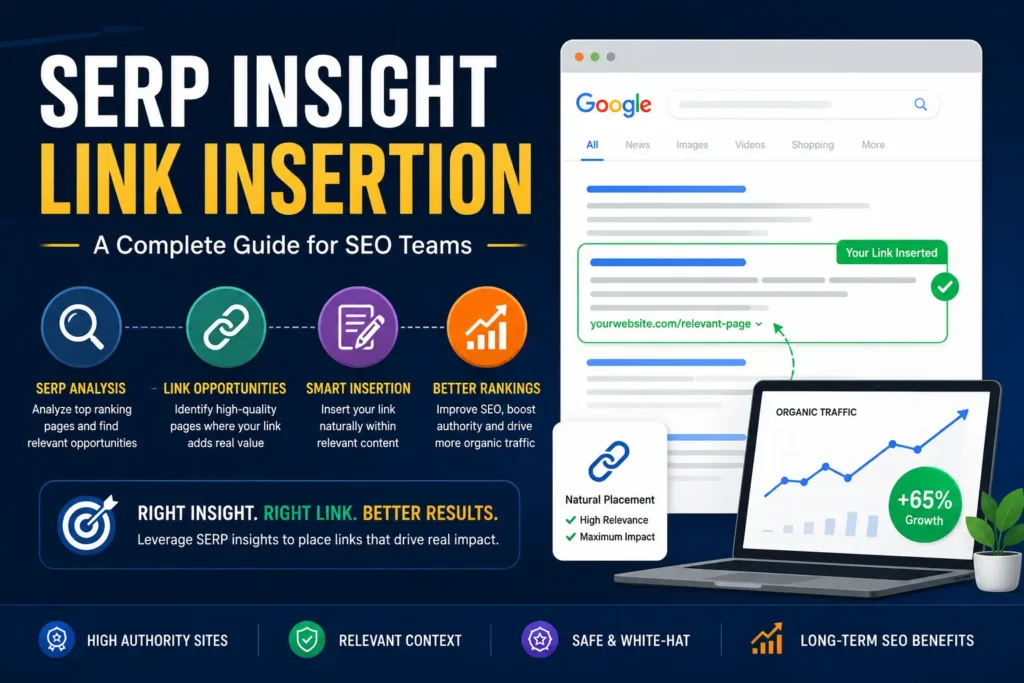
SERP insight link insertion is a link building strategy that combines traditional niche edits with search engine results page (SERP) analysis. While many SEO providers market it as a separate service, the underlying technique is an enhanced version of a standard link insertion.
A link insertion (also called a niche edit) involves adding a backlink to an existing article that has already been published on another website. Unlike a guest post, no new article is created. Instead, an editor updates relevant content by naturally inserting your link where it provides additional value for readers.
The “SERP insight” component simply changes how the target page is selected. Instead of choosing any relevant article from a high-authority website, the focus shifts to pages that already rank well in Google for keywords related to your industry.
This data-driven approach helps marketers prioritize pages that have already earned Google’s trust and are actively receiving organic traffic.
If you’ve been offered a SERP insight link insertion and SERP Insight Guest Post service, understanding how it works will help you decide whether it’s the right investment for your SEO strategy.
What Is SERP Insight Link Insertion?
SERP insight link insertion is an SEO link building technique where a backlink is added to an existing, indexed article that already ranks in Google. The selection of the host page is based on SERP data rather than domain authority alone.
Instead of publishing brand-new content and waiting for search engines to crawl and evaluate it, this strategy leverages pages that have already demonstrated strong relevance and visibility.
The concept itself isn’t new. SEO professionals have been placing contextual backlinks into established content for years. What has changed is the growing emphasis on using keyword rankings, traffic trends, and page-level performance to identify stronger placement opportunities.
In simple terms:
- The backlink is placed inside an existing article.
- The article already ranks for relevant search queries.
- The placement is chosen using SEO data instead of assumptions.
The result is a more informed link acquisition process that focuses on page quality rather than relying solely on website-level metrics.
Why the “SERP Insight” Matters
The phrase SERP insight refers to analyzing Google’s search ai results before deciding where to place a backlink.
Rather than selecting a page simply because it belongs to a website with a high Domain Rating (DR), SEO professionals review search performance to identify pages that Google already considers authoritative for a particular topic.
The process typically includes:
- Searching the target keyword in Google
- Reviewing pages that consistently rank well
- Evaluating topical relevance
- Checking organic traffic
- Analyzing keyword rankings
- Identifying pages suitable for contextual link placement
This approach reduces guesswork and helps ensure the backlink appears on a page with demonstrated search visibility.
SERP Insight Link Insertion vs Traditional Niche Edits
Both strategies involve adding backlinks to existing content, but the page selection process differs.
Traditional Niche Edit
With a conventional niche edit, the focus is usually on finding a relevant website with strong authority metrics.
The typical workflow looks like this:
- Identify a relevant website.
- Review its authority metrics.
- Locate an appropriate article.
- Request a contextual backlink.
The decision is often influenced primarily by domain-level signals.
SERP Insight Link Insertion
A SERP insight campaign begins with keyword research rather than website research.
The workflow generally follows this sequence:
- Search Google using the target keyword.
- Review pages currently ranking in the search results.
- Evaluate each page’s SEO performance.
- Contact the website owner.
- Negotiate a contextual link placement.
- Add the backlink naturally within the existing article.
Although the backlink placement process remains largely the same, the selection of the host page is supported by real search performance data.
Why Ranking Pages Are Often Better Link Opportunities
A webpage that consistently appears in Google’s search results has already demonstrated several positive SEO signals.
These pages commonly have:
- Strong topical relevance
- Existing organic traffic
- Stable keyword rankings
- Regular search engine crawling
- Established authority within their niche
Because Google revisits high-performing pages more frequently than inactive content, newly added backlinks may be discovered sooner after publication.
This doesn’t guarantee higher rankings for your own website, but placing links within actively indexed, well-performing pages generally provides a stronger foundation than inserting links into neglected or low-traffic articles.
It’s important to remember that page-level quality often matters more than domain-level metrics alone. A website may have a high Domain Rating while individual pages receive little or no organic traffic.
For this reason, experienced SEO professionals evaluate both the website and the specific page before investing in a placement.
Understanding the Link Insertion Process
The second half of the strategy is the actual link insertion.
A link insertion means updating an existing article by adding a contextual backlink within relevant body content.
An editor typically:
- Opens an already published article.
- Identifies a section where your resource fits naturally.
- Adds the backlink within an existing paragraph.
- Updates the article.
- Republishes or saves the revised content.
Unlike guest posting, this process doesn’t require writing a completely new article.
The effectiveness of the placement largely depends on how naturally the link integrates with the surrounding content. Editorial relevance is significantly more valuable than forcing a backlink into unrelated text.
Is SERP Insight Link Insertion Really Different from a Niche Edit?
From a technical perspective, no.
SERP insight link insertion is essentially a niche edit enhanced with search performance analysis.
The backlink placement remains identical.
The outreach process remains similar.
The negotiation with publishers also stays largely unchanged.
The key distinction is that SERP insight campaigns use Google search data to determine which existing page deserves the backlink instead of selecting pages based solely on website authority.
This additional research helps prioritize pages with stronger ranking potential, making the placement strategy more informed rather than fundamentally different.
How SERP Insight Link Insertion Works
Although every SEO agency follows its own workflow, successful campaigns generally move through five core stages:
- Identify ranking pages.
- Evaluate page quality.
- Confirm a natural placement opportunity.
- Select appropriate anchor text.
- Publish and monitor the backlink.
Each stage contributes to the overall effectiveness of the campaign.
Stage 1: Find Pages That Already Rank in Google
The first step is identifying pages that already perform well for your target keyword.
Instead of starting with a list of websites, begin by searching Google for the exact keyword you want to improve rankings for.
Focus on pages appearing within the first few pages of search results, typically positions 1 through 30.
These pages have already earned visibility through a combination of relevance, authority, and content quality.
During this stage, evaluate questions such as:
- Does the article closely match your topic?
- Would your resource genuinely help readers?
- Is there a logical place where your link could fit naturally?
The objective isn’t simply finding an available website but identifying content where your backlink improves the overall user experience.
Stage 2: Evaluate the Individual Page Not Just the Website
One of the biggest mistakes in link building is relying entirely on domain-level metrics.
A website may have impressive authority scores while individual pages receive little traffic or have lost their rankings over time.
Before requesting any placement, review the page itself.
Important page-level signals include:
Organic Traffic
Is the page attracting visitors from search engines?
Steady traffic suggests Google continues to value the content.
Keyword Rankings
Does the page rank for meaningful keywords related to its topic?
Ranking for multiple relevant search terms often indicates topical authority.
Ranking Stability
Has the page maintained consistent visibility over several months?
Stable rankings usually provide a stronger placement opportunity than pages experiencing continual decline.
Content Freshness
Has the article been updated recently?
Pages that receive occasional updates often continue attracting search engine crawls and user engagement.
Evaluating page-level performance helps separate valuable editorial opportunities from placements that exist only on paper.
Why Page-Level Metrics Matter More Than Domain Rating
Domain Rating (DR) is a useful SEO metric, but it measures the backlink strength of an entire website not the performance of an individual article.
A website with a DR of 80 may still contain thousands of outdated pages that receive no traffic whatsoever.
Conversely, a page on a DR 40 website might generate substantial organic traffic because it perfectly satisfies search intent.
For link insertion campaigns, the page itself is usually the true asset.
A backlink placed on an actively ranking page often provides more value than one inserted into forgotten content on a larger website.
That is why modern link builders increasingly evaluate both page-level and domain-level metrics together instead of relying on a single authority score.
Stage 3: Confirm There’s a Natural Place for the Link
Not every high-ranking page is suitable for a link insertion. Even if a page has excellent organic traffic and strong authority, forcing a backlink into unrelated content can reduce its effectiveness and create an unnatural user experience.
The primary goal of a SERP insight link insertion is to enhance the article—not interrupt it.
Before requesting a placement, review the existing content carefully and ask:
- Does the article discuss a topic related to your page?
- Can your resource provide additional value to readers?
- Will the link fit naturally within the surrounding paragraph?
- Would the sentence still read smoothly if the hyperlink were removed?
If the answer is yes, the page is likely a good candidate.
Prioritize Editorial Relevance
Google increasingly rewards content that demonstrates topical relevance and serves user intent. A backlink placed in a relevant section of an article is generally more valuable than one added simply because the page has strong authority metrics.
For example, if your page covers technical SEO audits, inserting a link into an article discussing SEO checklists makes sense. However, adding the same link to an article about email marketing or social media advertising would appear forced and offer little value to readers.
Editorial context matters.
A quality placement should feel like a helpful recommendation rather than a paid promotion.
Avoid Forced Link Placements
One of the easiest ways to identify low-quality link building is by looking for awkward insertions.
Common warning signs include:
- Links placed in unrelated paragraphs
- Sentences rewritten solely to include a keyword
- Excessive commercial anchor text
- Multiple outbound links stuffed into a single paragraph
- Content that clearly prioritizes SEO over readability
If the placement feels unnatural to a human reader, there’s a good chance search engines will also recognize the manipulation.
Whenever possible, work with publishers who maintain editorial standards instead of accepting every paid request.
Stage 4: Choose Anchor Text That Looks Natural
Anchor text is the clickable text that contains your hyperlink.
Although anchor text has always been an important ranking signal, modern SEO places far greater emphasis on natural language than exact keyword repetition.
Rather than optimizing every backlink with the same commercial keyword, successful link profiles use a balanced mix of anchor text variations.
Why Anchor Text Matters
Anchor text helps search engines understand the relationship between two pages.
It also provides context for readers before they click.
Well-written anchor text should:
- Describe the destination page accurately
- Fit naturally into the sentence
- Improve readability
- Match the surrounding topic
When used correctly, anchor text enhances both user experience and topical relevance.
Types of Anchor Text
A diversified backlink profile typically includes several anchor text formats.
Brand Anchors
These use your company or website name.
Examples:
- YourBrand
- YourBrand SEO
- Visit YourBrand
Brand anchors are among the safest options because they closely resemble natural editorial citations.
Partial-Match Anchors
These include part of the target keyword while remaining conversational.
Examples:
- guide to technical SEO
- improving local SEO performance
- link building strategies for startups
Partial-match anchors provide keyword relevance without appearing manipulative.
Generic Anchors
Generic phrases include:
- Learn more
- Read this guide
- Explore the article
- View the full resource
Although they pass less topical information, they help diversify your backlink profile.
Naked URL Anchors
Sometimes the URL itself becomes the anchor.
For example:
- example.com
- www.example.com
These commonly appear in citations, references, and resource pages.
Avoid Over-Optimized Anchors
Repeatedly using the exact same keyword across multiple backlinks creates a predictable footprint.
Examples of over-optimized anchors include:
- Best SEO agency
- Buy backlinks
- Cheap link building services
When every backlink uses identical commercial phrases, the pattern becomes increasingly obvious.
Instead, rotate between:
- Brand anchors
- Partial-match keywords
- Topical phrases
- Generic anchors
- Natural citations
The objective is to build a backlink profile that resembles genuine editorial recommendations.
Stage 5: Publish the Link and Monitor Performance
After the placement goes live, the campaign isn’t finished.
Backlink monitoring is an essential part of long-term SEO.
Websites change ownership.
Editors update articles.
Pages are deleted.
Outbound links are occasionally removed without notice.
Without regular monitoring, valuable backlinks can disappear months after publication.
Where Should the Link Be Placed?
The strongest placements are usually found inside the main body of an article.
Contextual links embedded within relevant paragraphs tend to provide more value than links placed in:
- Author bios
- Sidebars
- Website footers
- Blogrolls
- Comment sections
Readers naturally engage with links that appear within useful content, making contextual placements the preferred choice for both user experience and SEO.
Monitor Every Placement
After publication, keep track of important details such as:
- Live URL
- Publication date
- Anchor text
- Target page
- Index status
- Organic traffic
- Keyword rankings
Many SEO professionals maintain backlink tracking spreadsheets or use specialized monitoring tools to receive alerts whenever a placement changes.
Consistent monitoring helps protect your investment and ensures your backlink profile remains healthy over time.
How Much Does SERP Insight Link Insertion Cost?
Pricing varies widely depending on the quality of the publisher, editorial standards, organic traffic, and outreach effort.
Generally, the market falls into two categories:
Premium Editorial Placements
High-quality manual outreach campaigns typically cost between $200 and $500 per backlink.
Pricing often depends on factors such as:
- Website authority
- Organic traffic
- Industry competitiveness
- Editorial quality
- Publisher responsiveness
- Content relevance
This pricing usually includes:
- Prospect research
- Outreach
- Publisher communication
- Placement negotiation
- Editorial review
- Link insertion
Since these placements involve direct communication with website owners, they often require more time and effort but typically provide higher-quality opportunities.
Budget Link Placements
Lower-priced services generally range from $50 to $150 per backlink.
While affordable options may seem attractive, the quality often varies significantly.
Some placements originate from:
- Low-traffic blogs
- Sites built primarily for selling backlinks
- Expired domains
- Thin-content websites
- Private publishing networks
Not every inexpensive placement is poor quality, but buyers should evaluate opportunities carefully rather than focusing solely on price.
The true value of a backlink comes from its relevance, visibility, and editorial quality—not simply its existence.
Are SERP Insight Link Insertions Really Cheaper Than Guest Posts?
Many providers claim that SERP insight link insertions cost 60% to 80% less than guest posting.
While this comparison appears attractive, the reality is more nuanced.
Guest posting usually involves:
- Topic research
- Content creation
- Editorial review
- Publishing a new article
- Link placement
Since the publisher doesn’t need to produce new content for a link insertion, production costs are naturally lower.
However, the actual pricing difference depends on several factors, including:
- Industry
- Publisher quality
- Content requirements
- Outreach complexity
- Editorial standards
In many cases, quality link insertions may cost moderately less than premium guest posts, but broad percentage claims shouldn’t be viewed as industry benchmarks.
Every campaign should be evaluated based on its objectives, publisher quality, and expected return rather than marketing comparisons alone.
How Long Does It Take to See Results?
There is no universal timeline for SEO results.
The impact of a SERP insight link insertion depends on several variables, including:
- Google’s crawl frequency
- Page authority
- Competition
- Search intent
- Existing backlink profile
- Overall website quality
Some websites notice ranking improvements within a few weeks, while others require several months before measurable changes appear.
SEO remains a long-term strategy rather than an instant ranking solution.
What Influences the Timeline?
Google’s Crawling Schedule
Google regularly revisits websites to discover updates.
Pages with consistent traffic and frequent content updates are generally crawled more often than inactive pages.
If your backlink is added to an actively maintained article, search engines may discover the update sooner.
Ranking Reassessment
After Google indexes the updated page, its algorithms begin evaluating how the new backlink affects the destination page.
This reassessment doesn’t happen immediately.
Ranking signals are processed gradually, and improvements often occur over time rather than overnight.
Website Quality
Even a strong backlink cannot compensate for weak content.
If your destination page lacks:
- Comprehensive information
- Strong internal linking
- Clear search intent
- Technical optimization
the backlink alone may produce limited ranking improvements.
The best-performing campaigns combine high-quality backlinks with excellent on-page SEO.
Why On-Page SEO Still Matters
SERP insight link insertion should support an already optimized page not replace proper SEO.
Before investing in backlinks, ensure your content includes:
- Clear keyword targeting
- Helpful, original information
- Strong topical coverage
- Logical internal links
- Fast loading performance
- Mobile-friendly design
- High-quality user experience
When these fundamentals are already in place, contextual backlinks can strengthen existing authority signals and improve overall search visibility.
Link building works best when combined with strong content, technical optimization, and a well-structured website not as a standalone ranking shortcut.
Google’s Position on SERP Insight Link Insertions
Before investing in any link building strategy, it’s important to understand how Google views backlinks that involve outreach, payments, or editorial placements.
Google does not recognize “SERP Insight Link Insertion” as an official SEO technique. From Google’s perspective, it is simply another method of acquiring backlinks.
What matters isn’t the name of the strategy it’s how the link is earned and implemented.
Google’s spam policies clearly state that links intended to manipulate search rankings violate its guidelines when they are bought or exchanged without proper disclosure.
If a backlink is placed because payment was exchanged, Google expects publishers to use attributes such as:
rel="sponsored"rel="nofollow"
These attributes tell search engines that the link should not pass ranking signals in the same way as a naturally earned editorial link.
Editorial Links vs Paid Link Placements
Not every link insertion violates Google’s guidelines.
The key difference lies in why the link was added.
Editorial Link Insertions
An editorial placement happens when a website owner or editor decides to include your link because it genuinely improves the article and provides additional value to readers.
Characteristics include:
- No obligation to publish the link
- Editorial review before approval
- Strong topical relevance
- Reader-first placement
- Natural integration within the content
These links are generally considered the most valuable because they’re earned based on quality rather than payment.
Paid Link Insertions
Paid placements occur when a website accepts compensation specifically for adding a backlink.
Although many publishers charge editorial or publishing fees, Google expects sponsored relationships to be disclosed appropriately.
If paid links are used solely to influence rankings without proper attributes, they may violate Google’s spam policies.
For businesses, this highlights the importance of working with reputable publishers and maintaining a long-term, quality-focused SEO strategy instead of chasing shortcuts.
Evaluating SERP Insight Link Insertion Providers
Not every agency follows the same standards.
Some providers focus on editorial quality and long-term SEO value, while others prioritize volume over relevance.
Before purchasing link placements, evaluate both the provider and the websites they use.
A trustworthy SEO partner should be transparent about:
- Website selection
- Outreach process
- Placement methodology
- Editorial standards
- Reporting
- Replacement policies
If important details remain unclear, it’s worth asking additional questions before moving forward.
Five Questions to Ask Before Buying SERP Insight Link Insertions
The quality of a backlink depends far more on the placement than the sales pitch.
These five questions can help you identify whether a provider follows best practices.
Can You Show the Target Page Before Payment?
A reputable provider should be willing to share the proposed placement or at least provide enough information for evaluation before final approval.
Review the page carefully.
Ask yourself:
- Is the content relevant?
- Does the page rank for meaningful keywords?
- Does it receive organic traffic?
- Is the article well written?
- Would your audience benefit from the link?
Transparency is usually a positive sign.
Can You Share Page-Level SEO Metrics?
Website authority alone doesn’t tell the full story.
Instead of relying only on domain-level metrics, request information about the individual page, such as:
- Organic traffic
- Ranking keywords
- Search visibility
- Content relevance
- Recent performance trends
Page-level performance often provides a more accurate picture of a placement’s potential value.
Where Will the Link Be Added?
Context matters.
The strongest placements are usually located inside the main content where readers naturally encounter them.
Ask whether the backlink will appear:
- Inside the article body
- Within a relevant paragraph
- Surrounded by related content
Links placed in author bios, sidebars, or footers generally provide less contextual value than links integrated directly into editorial content.
Can You Choose the Anchor Text Together?
Experienced SEO providers typically collaborate with clients when selecting anchor text.
The goal isn’t to force exact-match keywords into every backlink.
Instead, anchor text should:
- Match the surrounding sentence
- Read naturally
- Reflect the destination page accurately
- Support a diverse backlink profile
Flexibility usually indicates a more thoughtful approach to link building.
What Happens if the Link Is Removed?
Backlinks don’t always remain online permanently.
Articles may be updated.
Websites may change ownership.
Editors occasionally remove outbound links.
Ask whether the provider offers:
- Link monitoring
- Replacement policies
- Reporting updates
- Performance tracking
Having a documented replacement policy can provide additional confidence, particularly for long-term campaigns.
When SERP Insight Link Insertions Make Sense
Like every SEO strategy, link insertions work best under specific conditions.
They’re most effective when supporting pages that already have a strong SEO foundation.
Ideal situations include:
- Existing content targeting competitive keywords
- Pages already ranking within the top 30 search results
- Well-optimized on-page SEO
- Strong topical authority
- Healthy internal linking
- Established website credibility
In these cases, additional high-quality backlinks may help strengthen existing ranking signals.
When This Strategy May Not Be the Right Choice
SERP insight link insertion isn’t always the best investment.
For brand-new websites with minimal content, backlinks alone rarely solve ranking challenges.
You may achieve better long-term results by first investing in:
- Comprehensive content creation
- Technical SEO improvements
- Site architecture
- Internal linking
- Topic clusters
- User experience enhancements
Once your website has established a solid content foundation, link building typically becomes much more effective.
Build the Foundation Before Scaling Links
A common misconception is that backlinks alone drive rankings.
In reality, backlinks amplify pages that already deserve visibility.
If your content lacks depth, search intent alignment, or topical authority, even high-quality backlinks may deliver limited results.
Think of link insertions as an accelerator not the engine itself.
Strong SEO combines:
- Helpful content
- Technical optimization
- Internal linking
- User experience
- High-quality backlinks
Each element supports the others.
SERP Insight Link Insertion vs Other Link Building Strategies
Different link building techniques serve different goals.
Here’s how they generally compare.
| Strategy | Best For | Content Required | Level of Control | Typical Effort |
|---|---|---|---|---|
| SERP Insight Link Insertion | Strengthening existing rankings | No | Medium | Medium |
| Traditional Niche Edit | Contextual backlinks | No | Medium | Medium |
| Guest Posting | Building authority and relationships | Yes | High | High |
| Digital PR | Brand visibility and editorial mentions | Sometimes | Low | High |
| Journalist Outreach | Earning media citations | No | Low | High |
No single strategy is universally better.
Many successful SEO campaigns combine multiple approaches to create a diverse, natural backlink profile.
Choosing the Right Strategy
Consider your goals before selecting a link building approach.
Choose SERP insight link insertions when:
- You already have high-quality content.
- Your page is close to ranking higher.
- You want contextual backlinks from relevant articles.
- You prefer updating existing content instead of publishing new articles.
Guest posting may be more appropriate when:
- You want complete control over the content.
- You’re entering a new niche.
- Brand awareness is equally important.
- You want long-term relationships with publishers.
Digital PR often works best for:
- Launch announcements
- Original research
- Data-driven content
- Industry reports
- Brand storytelling
A balanced SEO strategy often incorporates several of these techniques rather than relying exclusively on one.
Best Practices for Successful SERP Insight Link Insertions
To maximize long-term value, follow these principles:
- Prioritize relevance over authority metrics alone.
- Evaluate pages individually not just domains.
- Use natural, reader-focused anchor text.
- Avoid excessive exact-match keywords.
- Focus on editorial-quality placements.
- Track every published backlink.
- Diversify your link acquisition strategy.
- Continue improving your on-page SEO alongside link building.
- Build links gradually instead of aggressively.
- Measure results using organic traffic and keyword growth rather than backlink quantity alone.
Quality consistently outperforms volume.
Final Thoughts
SERP insight link insertion isn’t a revolutionary SEO technique it’s an evolution of the traditional niche edit.
The real advantage comes from using search data to identify stronger placement opportunities instead of relying solely on website authority metrics.
When combined with helpful content, technical SEO, and a strong internal linking structure, this strategy can support long-term organic growth.
However, backlinks should never replace content quality.
The pages that benefit most from contextual link insertions are those that already satisfy search intent, provide valuable information, and demonstrate topical expertise.
Think of SERP insight link insertion as one component of a broader SEO strategy rather than a standalone ranking solution.
Frequently Asked Questions
Can I perform SERP insight link insertion without hiring an agency?
Yes. The process involves researching ranking pages, evaluating their quality, identifying relevant placement opportunities, reaching out to website owners, and tracking published backlinks. While the workflow is straightforward, it can require significant time and consistent outreach efforts.
What tools are useful for SERP insight link insertion?
Common SEO tools include platforms for keyword research, backlink analysis, traffic estimation, and outreach management. Many professionals also maintain spreadsheets to organize prospects, monitor placements, and track campaign performance.
Does this strategy work for new websites?
It can, but results are often limited if the website lacks strong content and topical authority. Building comprehensive content and improving technical SEO usually provides a stronger foundation before investing heavily in link acquisition.
What type of anchor text works best?
Natural, descriptive anchor text generally performs better than repetitive exact-match keywords. A healthy backlink profile typically includes a balanced mix of brand anchors, partial-match phrases, generic anchors, and topical variations.
How many SERP insight link insertions should I build?
There is no universal number. The ideal volume depends on your industry, competition, content quality, and overall SEO strategy. Consistent, high-quality placements usually outperform aggressive link building campaigns focused purely on quantity.
Are SERP insight link insertions better than guest posts?
Neither strategy is inherently better. Link insertions leverage existing ranking pages, while guest posts provide complete editorial control and new content opportunities. Many successful SEO campaigns combine both approaches to create a diverse backlink profile.