Analysing competitor backlinks is an effective way to understand how competing websites are building their authority and attracting links from other websites. It can also reveal link-building opportunities that may be relevant to your own SEO strategy.
Fortunately, tools like Ahrefs make it easier to investigate a competitor’s backlink profile, identify valuable referring domains, and understand where their links are coming from. In this guide, you’ll learn how to analyse competitor backlinks using Ahrefs and turn the findings into practical link-building opportunities.
Why Competitor Backlink Analysis Matters
Your competitors may already have backlinks from websites that are relevant to your industry. Studying those links can help you understand the types of websites, content, and outreach strategies contributing to their backlink profiles.
There are several reasons to analyse competitor backlinks:
- Find new link opportunities: Competitor backlinks can reveal websites that may also be relevant to your brand.
- Understand link-building strategies: Looking at referring domains can show the types of websites competitors are targeting.
- Identify content gaps: If competitors are earning links to specific types of content, it may highlight topics worth covering on your own website.
- Improve outreach research: Analysing competitor links can help create a more focused prospect list instead of starting outreach from scratch.
The goal is not to copy every backlink a competitor has. Instead, the analysis should help identify relevant and realistic opportunities for your own website.
Using Ahrefs to Analyse Competitor Backlinks
Ahrefs provides several backlink analysis features that can help you investigate competing websites. Its Site Explorer allows you to examine referring domains, backlinks, anchor text, linked pages, and other useful information.
Here’s how you can use it to analyse your competitors.
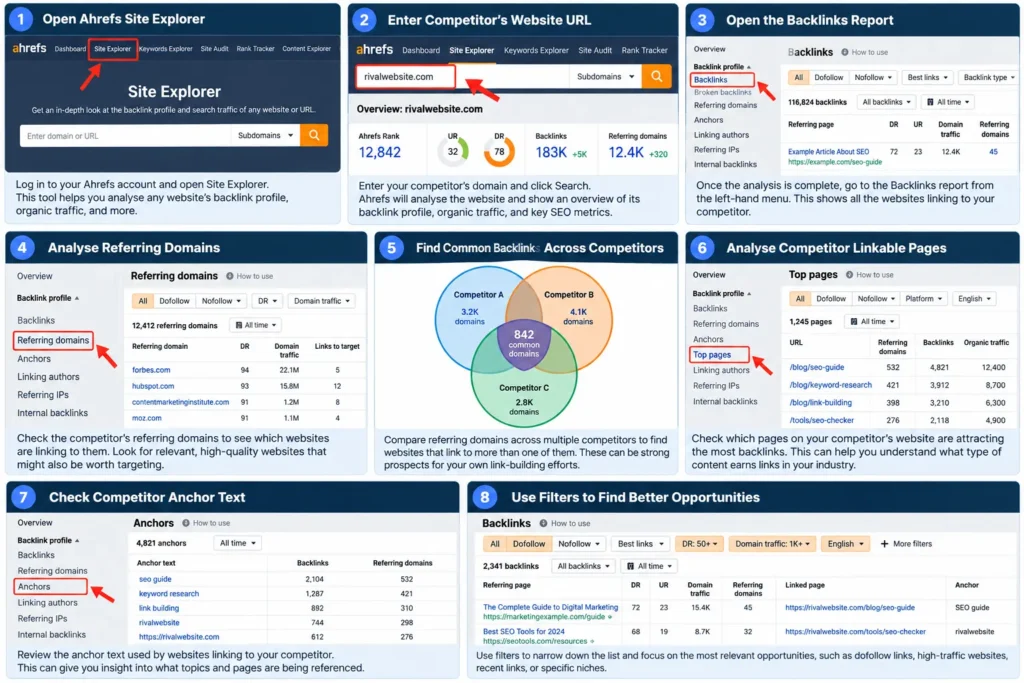
1. Identify Your Main Competitors
Before opening Ahrefs, determine which competitors you want to analyse.
Choose websites that compete with your business for the same audience, products, services, or search terms. Ideally, focus on competitors that are ranking for keywords you also want to target.
You do not need to analyse dozens of websites at once. Start with a small group of relevant competitors and compare their backlink profiles systematically.

2. Enter a Competitor’s Website in Site Explorer
Log in to Ahrefs and open Site Explorer.
Enter the competitor’s domain into the search bar and start the analysis.
Ahrefs will provide an overview of the website’s backlink profile, including information about referring domains, backlinks, organic search performance, and other SEO metrics.

This overview gives you a starting point before moving into the individual backlink reports.
3. Open the Backlinks Report
Once the competitor’s domain has been analysed, navigate to the Backlinks report.
This section provides a detailed view of websites linking to your competitor.
Review information such as:
- Referring page
- Referring domain
- Anchor text
- Target URL
- Link type
- Domain and page-level metrics
The report helps you move from a general competitor overview to the individual links that may be worth investigating.
4. Analyse Referring Domains
Next, examine the competitor’s referring domains.
Look for websites that are:
- Relevant to your industry
- Receiving genuine traffic
- Publishing content related to your niche
- Linking to multiple useful resources
- Potentially open to guest posts contributions or editorial links
Do not judge a prospect only by a high DR or DA number. A relevant website with genuine traffic and useful content may be more valuable for your outreach than a site with strong metrics but little topical relevance.
5. Find Common Backlinks Across Competitors
After analysing one competitor, repeat the process for the others.
Compare their referring domains to find websites that link to multiple competitors.
These sites can be particularly useful because they have already demonstrated an interest in your industry or topic.
A website linking to several competitors is not automatically guaranteed to link to you. However, it can provide a stronger starting point for prospect research and outreach.
6. Analyse Competitor Linkable Pages
Backlinks should not be analysed separately from the pages receiving them.
Check which pages on your competitors’ websites are attracting the most backlinks.
Look for patterns such as:
- Guides and tutorials
- Research or statistics pages
- Industry resources
- Original studies
- Tools and calculators
- Comprehensive informational content
This can help you understand what type of content naturally attracts links within your industry.
If competitors consistently earn links to a particular type of resource, consider whether your website has an equivalent asset or whether there is an opportunity to create something more useful.
7. Check Competitor Anchor Text
Review the anchor text used by websites linking to your competitors.
This can help you understand how their backlinks are being referenced and what topics or pages are receiving attention.
However, avoid copying competitor anchor-text patterns blindly.
Your own backlink profile should develop naturally, with anchor text that makes sense in the context of each referring page.
8. Filter the Backlinks for Better Opportunities
A competitor backlink report can contain a large number of links, and not all of them will be useful.
Use relevant filters to narrow the list.
For example, you may want to focus on:
- Dofollow backlinks
- Relevant referring domains
- Strong organic traffic
- Recently acquired backlinks
- Specific countries
- Specific niches or topics
Filtering the data makes the analysis more practical and helps reduce time spent reviewing irrelevant links.
How to Turn Competitor Backlinks Into Opportunities
Finding competitor backlinks is only the first stage. The real value comes from deciding which opportunities are relevant to your own website.
Once you identify relevant competitor backlink opportunities, blogger outreach and guest posting services can help turn those prospects into real link-building opportunities. A targeted outreach strategy connects your brand with relevant publishers and industry websites. With the right guest posting service, you can secure contextual backlinks through useful, audience-focused content rather than relying on irrelevant link placements.
Prioritise prospects based on factors such as:
- Topical relevance: Does the website cover your industry or audience?
- Website quality: Does it publish useful, original content?
- Organic visibility: Does the website appear to receive genuine search traffic?
- Link relevance: Would a link to your page make sense for its readers?
- Outreach potential: Is there a realistic reason to contact the website?
Once qualified prospects have been identified, add them to your outreach list along with the referring page, competitor being linked to, target page, contact information, and potential outreach angle.
Monitor Competitor Backlinks Regularly
Competitor backlink profiles are not static. New links can appear as competitors publish content, run campaigns, earn media coverage, or build new relationships.
Regularly checking competitor backlinks can help you identify new opportunities before your prospect list becomes outdated.
Instead of analysing competitors only once, make backlink monitoring part of your wider SEO research process.
Final Notes
Competitor backlink analysis can provide useful insight into how other websites in your industry are earning links and which websites are already interested in similar content.
Using Ahrefs, you can examine competitor backlinks, identify referring domains, compare multiple competitors, analyse linkable pages, and filter prospects based on the factors that matter to your SEO strategy.
The key is to use competitor backlinks as research data rather than a list to copy. Focus on finding relevant websites, understanding why competitors earned those links, and developing a stronger reason for those websites to link to your own content.

Narender Malik is an SEO strategist with 8 years of experience building search growth through technical SEO, authority-driven link building, and strategic blogger outreach. He takes a data-led approach to off-page SEO, identifying the right opportunities, publishers, and digital ecosystems to strengthen brand authority and organic performance. His work focuses on building sustainable SEO assets that deliver meaningful visibility, qualified traffic, and long-term growth.