Generative engine optimisation (GEO) has changed the way businesses think about search visibility. Instead of focusing only on where a webpage ranks in traditional search results, brands increasingly want to know whether their content will be discovered, understood, and referenced by AI-powered search platforms.
That raises an important question: What makes an AI search engine consider one source more credible than another?
One of the most useful frameworks for understanding this is Google’s E-E-A-T: Experience, Expertise, Authoritativeness, and Trustworthiness.
While E-E-A-T was developed in the context of Google’s search quality guidelines, its underlying principles are highly relevant to GEO. AI systems need reliable information to build useful answers, which makes credibility an increasingly important part of being visible in AI-generated search results.
What Is E-E-A-T?
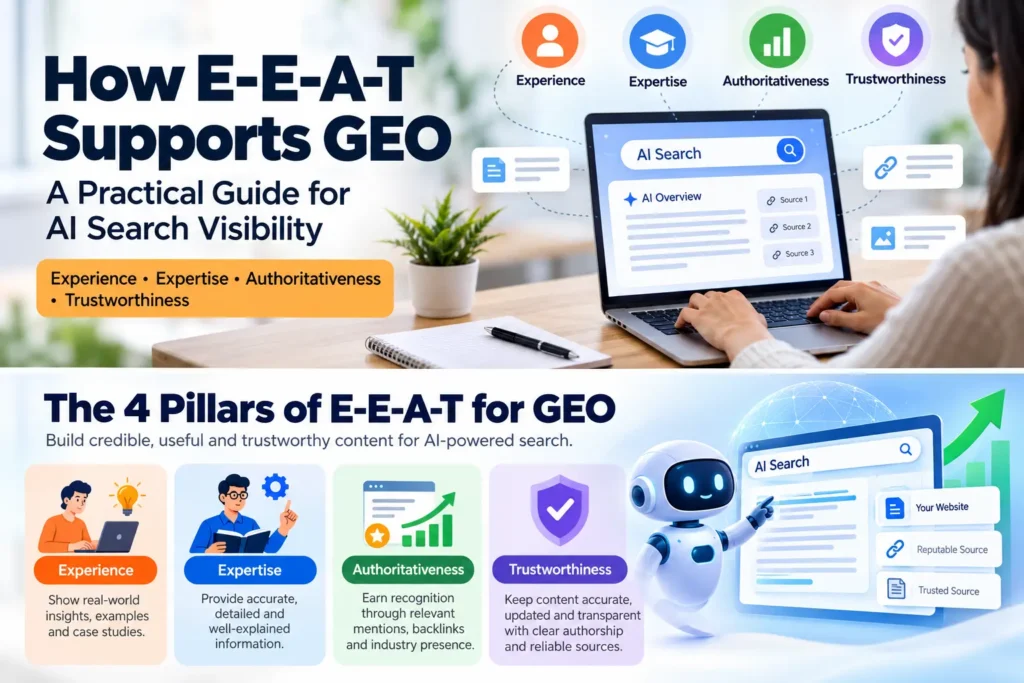
E-E-A-T stands for:
- Experience: Has the content creator actually experienced or worked with the subject?
- Expertise: Does the author demonstrate genuine knowledge of the topic?
- Authoritativeness: Is the website, author, or brand recognised as a credible source?
- Trustworthiness: Is the information accurate, transparent, and dependable?
Google uses these concepts as part of its broader approach to evaluating the quality of search results.
The addition of the second “E”, Experience, was particularly important because it highlighted the value of first-hand knowledge. Someone who has actually performed a task, tested a product, managed a campaign, or dealt with a problem can often provide insights that generic content cannot.
For GEO, these same qualities can help your content become a stronger source for AI-generated answers.
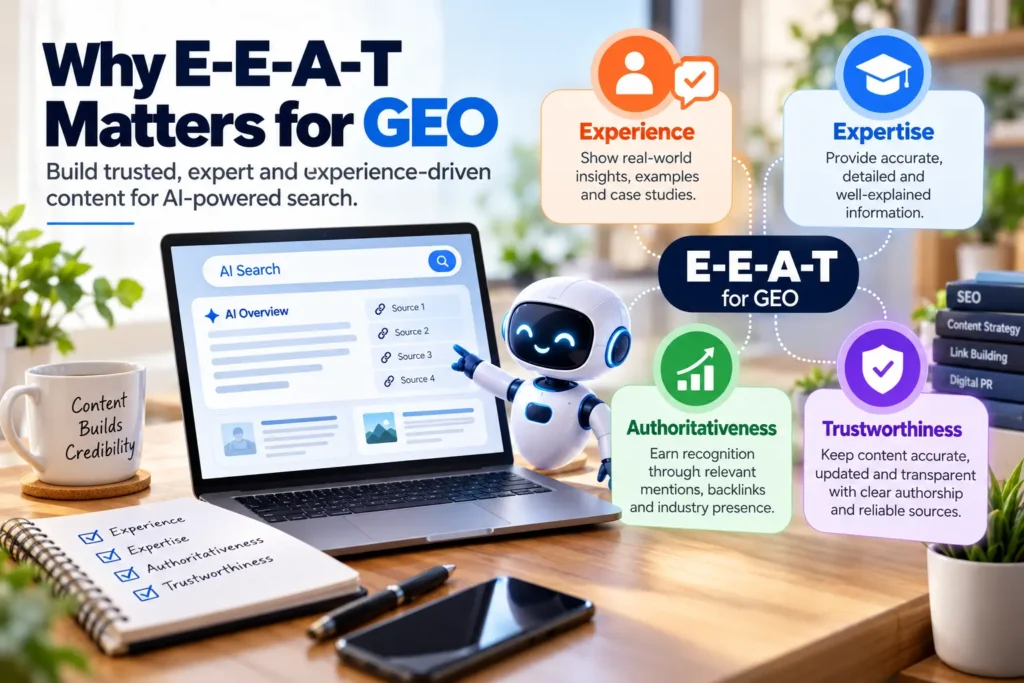
Why E-E-A-T Matters for GEO
Traditional search engines generally present users with a list of pages to explore. Generative search works differently.
Platforms such as Google AI Overviews, ChatGPT and Perplexity can synthesise information from multiple sources and use that information to produce a direct response.
This creates a different visibility opportunity for businesses.
Your goal isn’t simply to rank for a keyword. Your content also needs to provide information that an AI system can understand, evaluate, and potentially use when constructing an answer.
That makes factors such as:
- Demonstrated experience
- Accurate information
- Clear authorship
- Relevant supporting evidence
- Strong topical authority
- Third-party recognition
- Consistent brand information
increasingly important.
There is no guarantee that meeting E-E-A-T principles will cause an AI platform to cite your website. However, creating genuinely trustworthy and useful content gives your site a much stronger foundation for both traditional search and AI-driven discovery.
How Each Part of E-E-A-T Applies to GEO
Experience: Demonstrate What You Actually Know
Experience is one of the easiest ways to make content more useful and distinctive.
A large amount of online content repeats the same general advice. AI systems can already generate basic explanations, definitions, and lists. What makes human-created content more valuable is often the information that comes from actually doing the work.
For example, an SEO agency writing about blogger outreach could simply explain what outreach is.
A more useful article could explain:
- How prospects were actually identified
- Which outreach approaches produced responses
- What caused publishers to reject campaigns
- How website quality was evaluated
- What changed after testing different email approaches
- What results were achieved
These details demonstrate experience rather than simply claiming it.
If your business has conducted campaigns, tested strategies, worked with customers, or collected original data, bring those experiences into your content.
Don’t just say you have experience. Show it.
Expertise: Go Beyond Basic Information
Expertise is about demonstrating a meaningful understanding of the subject.
For GEO, this becomes particularly important because AI-generated answers often need to combine information from several sources. Content that provides clear explanations, useful context, supporting evidence, and meaningful detail is more valuable than a page created primarily to target a keyword.
A strong article should answer the obvious question, but it should also anticipate what the reader is likely to ask next.
For example, an article about link building shouldn’t stop at explaining what a backlink is. It could also address relevance, anchor text, editorial placement, link quality, outreach methods, common mistakes, and how to evaluate results.
That depth makes the content more useful to people and easier for search systems to understand.
At the same time, expertise doesn’t mean making an article unnecessarily complicated.
The best expert content explains difficult concepts clearly.
Authoritativeness: Build Recognition Beyond Your Website
Authority isn’t created entirely on your own domain.
Your website can publish excellent content, but third-party recognition can strengthen how your brand is perceived across the wider web.
This is where digital PR, editorial mentions, industry contributions, relevant backlinks, interviews, expert commentary, and other forms of external recognition can become valuable.
Consider two companies publishing similar information.
One has very little presence outside its own website.
The other is regularly mentioned by relevant publications, has experts contributing to industry discussions, and earns links from credible websites.
The second brand has stronger external signals demonstrating that it is recognised within its field.
For GEO, this broader brand presence matters because AI search systems can draw information from multiple sources when developing an understanding of a company, topic, or entity.
Build Topical Authority, Not Just Backlinks
Backlinks can contribute to authority, but the goal shouldn’t be collecting links from as many websites as possible.
Relevance matters.
A marketing company will generally benefit more from being referenced by relevant marketing, business, technology, or industry publications than from receiving large numbers of unrelated links.
The same principle applies to brand mentions.
Build a consistent presence around the subjects you genuinely understand.
Over time, this can help establish your website and brand as a recognised resource within your niche.
Trustworthiness: The Foundation of GEO Visibility
Of the four E-E-A-T components, trust is arguably the foundation supporting everything else.
AI search platforms need to provide users with useful answers. If the information they rely on is inaccurate, outdated, misleading, or poorly supported, the quality of the resulting answer suffers.
That means businesses should make trustworthiness a core part of their content strategy.
Keep Information Accurate and Current
Review important content regularly.
Statistics change. Industry practices evolve. Products are updated. Search algorithms change. Regulations can also change.
If an article contains outdated information, update it rather than allowing it to remain published indefinitely.
Where appropriate, link to reliable sources and clearly explain where important facts or statistics come from.
Make Authors Easy to Identify
Readers should be able to understand who created your content and why that person is qualified to discuss the subject.
A useful author profile can include:
- Relevant professional experience
- Areas of expertise
- Industry background
- Credentials where appropriate
- Links to other relevant contributions
This provides additional context around the person behind the information.
Maintain Consistency Across the Web
Your website shouldn’t tell one story about your company while third-party profiles tell another.
Keep important business information consistent across relevant platforms.
This includes your brand name, services, company information, expertise, and other important entity details.
Consistency helps create a clearer picture of who your business is and what it does.
Protect Your Online Reputation
Trust extends beyond individual articles.
Reviews, editorial coverage, customer experiences, brand mentions, and other public signals can all contribute to how a company is perceived.
A strong GEO strategy therefore shouldn’t focus exclusively on publishing more blog posts.
It should also consider the broader reputation and visibility of the brand.
How to Improve E-E-A-T for GEO
You don’t need to completely rebuild your website to start improving these signals.
Begin with the content you already have.
1. Add First-Hand Insights
Review your existing articles and identify places where you can add original examples, observations, campaign data, screenshots, case studies, or lessons learned.
2. Strengthen Author Profiles
Make it clear who writes your content and what qualifies them to discuss the subject.
3. Support Important Claims
Where you make factual or statistical claims, use credible sources and provide appropriate attribution.
4. Build Relevant External Recognition
Work on earning genuine mentions, editorial links, expert contributions, interviews, and PR coverage from relevant sources.
5. Update Existing Content
Don’t assume publishing new content is always the best solution.
Refreshing older pages with accurate information, better examples, updated statistics, and clearer explanations can make your existing content significantly more useful.
6. Create Content Around Your Actual Expertise
Don’t try to become an authority on every possible subject.
Focus on the topics your business genuinely understands.
This makes it easier to demonstrate experience, create deeper resources, and build a consistent topical presence.
E-E-A-T and GEO Work Together
GEO isn’t about finding a single optimisation trick that guarantees citations from AI search engines.
The landscape is still evolving, and different AI platforms use different systems and sources when generating answers.
What is becoming clearer, however, is the value of producing information that is useful, credible, specific, and supported by genuine expertise.
That’s why E-E-A-T provides such a useful framework.
Experience helps demonstrate that you’ve actually done the work.
Expertise shows that you understand the subject.
Authority demonstrates that others recognise your knowledge.
Trust gives users and search systems a reason to rely on your information.
Together, these qualities create a stronger foundation for search visibility across both traditional and generative search.
The Practical Takeaway
Optimising for GEO shouldn’t mean creating content specifically to impress an AI system.
Instead, focus on creating resources that would be genuinely valuable if an experienced human expert recommended them to someone.
Show what you’ve learned through real experience. Explain subjects thoroughly without making them unnecessarily complicated. Support important claims with credible evidence. Build recognition through relevant third-party sources. Keep your website accurate and transparent.
These practices can support traditional SEO while also helping your brand establish a stronger presence in the increasingly important world of AI-powered search.
The brands most likely to stand out won’t necessarily be those publishing the most content.
They’ll be the ones with something credible, useful, and distinctive to say.
Frequently Asked Questions About E-E-A-T and GEO
What is E-E-A-T in SEO?
E-E-A-T stands for Experience, Expertise, Authoritativeness, and Trustworthiness. Google uses these concepts within its search quality framework to help assess the quality and credibility of content.
Does E-E-A-T directly affect GEO?
E-E-A-T should not be treated as a direct ranking or citation factor for every AI search platform. However, its principles are highly relevant to GEO because AI-powered search systems need reliable, useful, and credible information when generating answers.
How does experience help with GEO?
First-hand experience can make content more useful and distinctive. Case studies, original research, campaign results, testing, examples, and practical lessons can demonstrate that the author has actually worked with the subject.
How can a website demonstrate expertise?
A website can demonstrate expertise by publishing accurate, detailed content created or reviewed by knowledgeable people. Author profiles, original research, expert commentary, supporting sources, and comprehensive topic coverage can all help establish credibility.
Why are backlinks important for E-E-A-T?
Relevant, editorially earned backlinks can contribute to a website’s authority and broader online visibility. However, backlink quantity alone does not establish E-E-A-T. Relevance, source quality, context, and the overall reputation of the website matter.
How can I improve trustworthiness for AI search?
Keep information accurate and updated, identify content authors, cite reliable sources, provide transparent business information, maintain consistency across the web, and actively manage your brand reputation.
Is E-E-A-T only important for Google?
No. Although E-E-A-T is a Google framework, the underlying principles are useful beyond traditional Google search. Creating trustworthy, expert, experience-based content is a sensible strategy for improving visibility across modern search and discovery systems.
Build Stronger Authority With Guest Post Outreach
Want to strengthen your website’s authority and improve its visibility across search and AI-powered platforms?
Our Guest Post Services , blogger Outreach , manual tech guest posting help brands earn relevant placements on quality websites, build authoritative backlinks, and increase their online presence through targeted outreach.
Ready to grow your website’s authority? Explore our Guest Post Outreach Services today.

Narender Malik is an SEO strategist with 8 years of experience building search growth through technical SEO, authority-driven link building, and strategic blogger outreach. He takes a data-led approach to off-page SEO, identifying the right opportunities, publishers, and digital ecosystems to strengthen brand authority and organic performance. His work focuses on building sustainable SEO assets that deliver meaningful visibility, qualified traffic, and long-term growth.