Last Updated: February 2026
Artificial intelligence is no longer influencing search it is redefining it.
In 2026, Google does not simply rank websites. It interprets, extracts, and generates answers.
This transformation has quietly created two categories of websites:
- Those cited and summarized inside Google AI Mode
- Those completely invisible in AI-generated answers
The difference is no longer just backlinks or keyword placement.
It is clarity, structure, and entity authority.
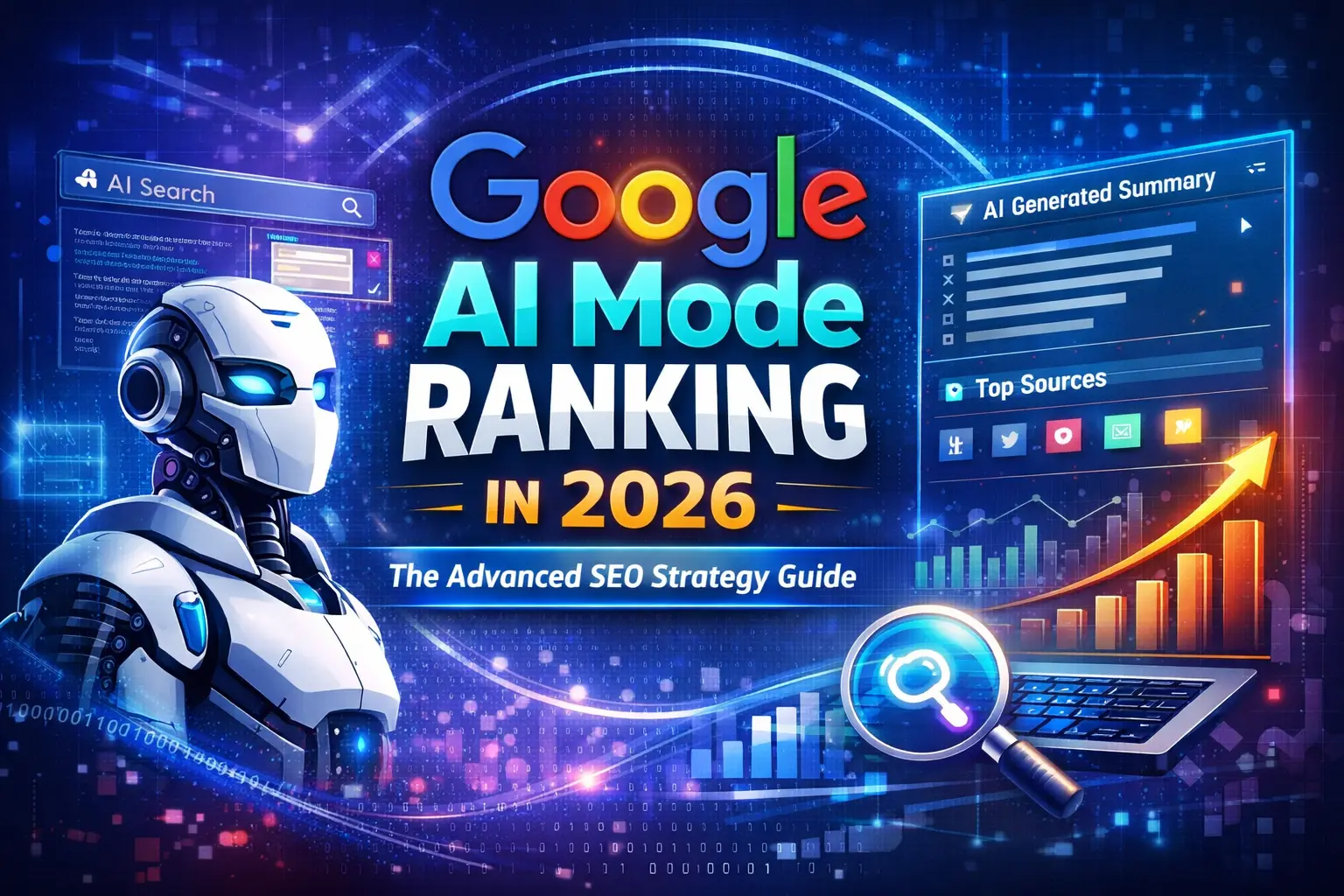
This guide explains not just what Google AI Mode is but how to strategically position your brand to become a preferred AI source.
Understanding Google AI Mode (Beyond the Basics)
Google AI Mode is an AI-powered search layer that analyzes top-ranking web pages and generates a synthesized answer before users click.
Instead of acting only as a directory of links, Google now acts as:
- A content interpreter
- A knowledge aggregator
- A response generator
This shift moves SEO from “ranking competition” to “information extraction competition.”
Your objective is no longer just visibility.
Your objective is to become extractable.
Traditional Search vs AI Mode The Structural Shift
| Traditional Search | Google AI Mode |
|---|---|
| Lists ranked pages | Generates summarized answers |
| User selects source | AI selects and filters content |
| Focus on position | Focus on clarity & reliability |
| Click-driven | Context-driven |
In AI Mode, Google reads your page before deciding whether to cite it.
If your content lacks structure, contains exaggerated marketing language, or hides key information inside fluff it becomes difficult for AI systems to use.
Structured knowledge wins.
Why AI Mode Optimization Is a Strategic Necessity
Many marketers assume AI search traffic is still small. That thinking mirrors early skepticism toward mobile SEO and voice search.
Technology adoption follows a clear cycle:
- Early doubt
- Gradual behavioral shift
- Dominant usage
AI-generated summaries are already reshaping how users consume information.
More importantly, AI visitors often demonstrate:
- Higher intent clarity
- Reduced confusion
- Stronger conversion behavior
When users click from AI summaries, they are not browsing they are validating.
This creates higher-quality traffic.
The Two-Pillar Framework for AI Ranking
Success in AI Mode requires alignment between:
1️⃣ Brand Authority (Entity Optimization)
2️⃣ Content Structure (Keyword & Context Optimization)
Ignoring either pillar weakens your visibility.
Brand Optimization — Engineering Authority
AI systems rely heavily on entity confidence. If Google cannot clearly define who you are, your brand authority weakens.
Step 1: AI Brand Audit
Search your name and company across AI tools and evaluate:
- Accuracy of expertise
- Location consistency
- Confusion with other entities
- Missing biographical details
If answers are incomplete or incorrect, strengthen your brand signals.
Step 2: Create Explicit Brand Pages
Every professional website should clearly present:
- Founder profile
- Experience timeline
- Service specialization
- Business location
- Contact information
- Social media profiles
- Media appearances
Avoid vague marketing phrases. Use direct factual statements.
Example:
Sonu Kumar is an SEO specialist based in Bihar Sharif, India, with over three years of experience in technical SEO, guest posting outreach campaigns, and performance marketing.
Clarity reduces AI confusion.
Step 3: Indexing & Consistency
- Ensure brand pages are indexed in Search Console.
- Maintain identical business information across platforms.
- Use structured data (Organization schema).
Consistency strengthens entity trust.
Keyword Optimization for AI Mode
Traditional SEO emphasized repetition and backlinks. AI Mode prioritizes:
- Semantic depth
- Structured clarity
- Accurate definitions
- Logical hierarchy
Before writing:
- Study how AI presents results.
- Identify whether summaries use lists, paragraphs, or hybrid format.
- Match structural expectations.
Instead of editing high-ranking legacy posts aggressively, create dedicated AI-optimized pages.
The Three Strategic Questions That Define AI Content
Every AI-optimized article must clearly answer:
Why
What is the purpose of this content?
Education? Strategy? Data analysis?
How
What validates the information?
Experience, research, case study, methodology?
Who
Who is the intended reader?
Beginners? Business owners? Advanced marketers?
AI personalization improves when audience definition is explicit.
Do Backlinks Still Matter?
Yes but differently.
Backlinks support domain authority.
AI Mode, however, evaluates:
- Extractable knowledge
- Structural organization
- Source reliability
- Clear expertise signals
A structured, high-clarity article may outperform a higher-authority but poorly formatted page inside AI summaries.
AI Optimization Implementation Checklist
Before publishing:
✔ Direct definition in first 100 words
✔ Logical H1–H3 structure
✔ Comparison table (when relevant)
✔ FAQ section
✔ Author bio
✔ Schema markup
✔ No keyword stuffing
✔ Clear target audience
✔ Updated publish date
Frequently Asked Questions (Premium Version)
What is Google AI Mode in SEO?
Google AI Mode is an AI-driven search experience where Google analyzes multiple high-ranking pages and generates a summarized answer while citing selected sources.
How does AI Mode change SEO strategy?
It shifts focus from keyword density to structured clarity, factual reliability, and entity authority.
Can small websites rank in AI Mode?
Yes. If content is well-structured, fact-based, and clearly authoritative, smaller websites can be cited in AI summaries.
Is AI Mode reducing organic traffic?
In some cases, informational clicks decrease. However, AI-generated traffic often demonstrates higher intent and conversion potential.
What type of content performs best in AI Mode?
Content that includes clear definitions, structured sections, logical hierarchy, factual backing, and audience clarity performs best.
Should I focus more on authority or formatting?
Both are essential. Authority builds trust; formatting improves extractability.

Leave a Reply